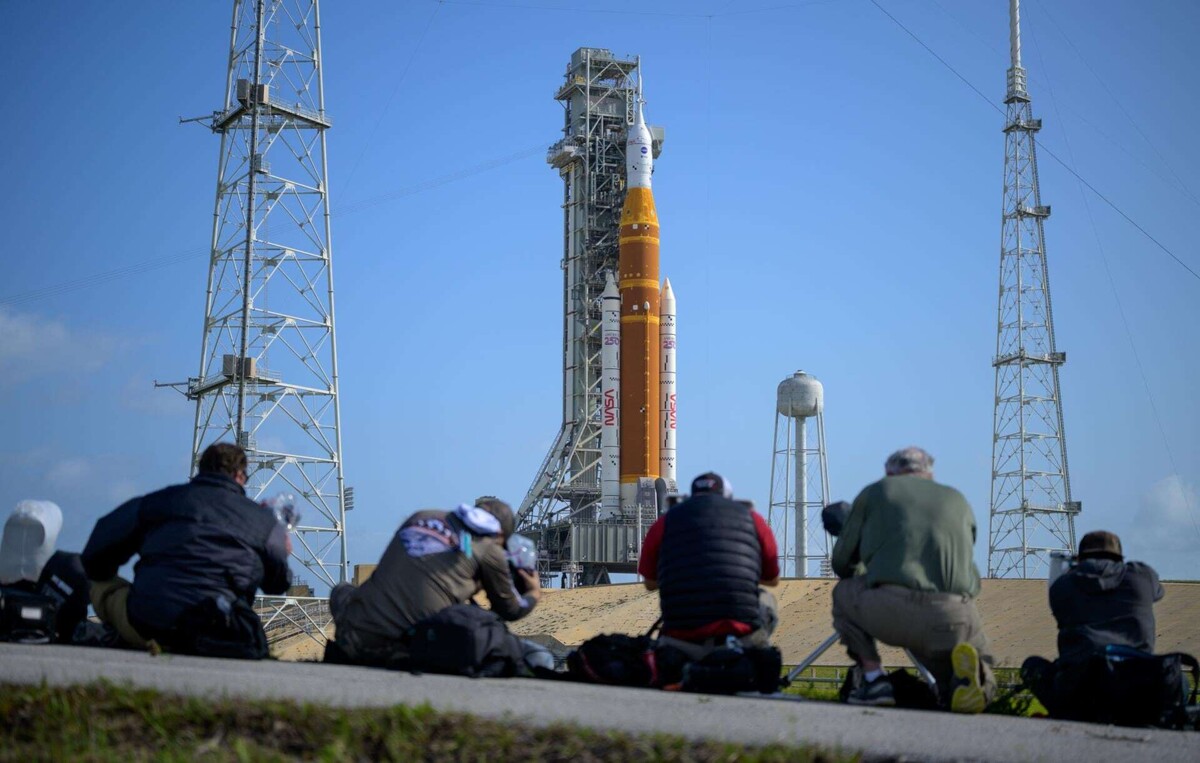
Engineers from the space agency are closely monitoring a phenomenon that jeopardizes the operation's safety: liquid hydrogen leaks. The Space Launch System (SLS) rocket, designed to carry the first human crew to lunar orbit in decades, uses this element as its primary fuel, despite the catastrophic risks involved in handling it. Hydrogen poses a major concern due to its chemical nature. It is the lightest molecule in the universe, allowing it to seep through microscopic cracks that are imperceptible to conventional inspection methods. As an extremely energetic and flammable element, any undetected accumulation in critical areas of the rocket poses a risk of a massive explosion that would endanger the astronauts' lives and the launchpad infrastructure. NASA acknowledges that containing hydrogen completely is practically impossible. For this reason, launch protocols establish a specific tolerance margin. Ground crews allow minor leaks to occur as long as they remain below the 16% threshold. The United States Congress mandated the space agency to use legacy hardware from the former Space Shuttle program. This directive forced designers to integrate systems that depend on liquid hydrogen, also inheriting the logistical and safety issues that characterized missions from decades past. The precision in handling this unstable fuel will define the success of Artemis II. While astronauts prepare for their historic journey, the safety of the launch rests in the hands of experts who monitor every millimeter of the SLS's connections, seeking to prevent the smallest molecule in space from causing the greatest disaster of the modern era. If sensors detect that the leak exceeds this limit during the cryogenic loading process, the countdown is immediately halted to prevent a catastrophe. The choice of hydrogen as fuel is not accidental but a response to a power requirement. According to Adam Swanger, a cryogenic research engineer at Kennedy Space Center, this component offers the best specific impulse (Isp) on the market. This metric defines the thrust efficiency a motor generates with a given amount of fuel; the high efficiency of hydrogen is what allows the SLS to overcome Earth's gravity with the heavy load of the Orion capsule. However, there is a factor external to engineering that conditioned the rocket's design. NASA faces one of its most complex technical challenges ahead of the upcoming Artemis II mission launch.