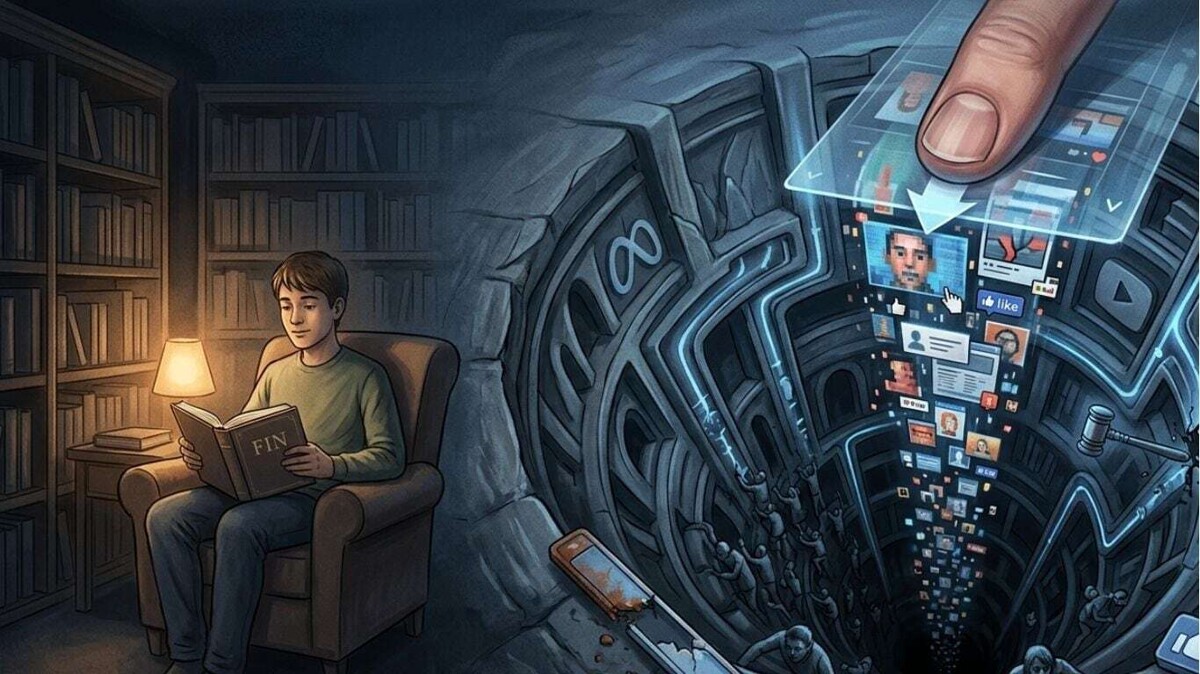
This has a name and several synonyms: prison, dungeon, cell, jail, cage, jail: a space conceived to limit freedom. This way, one could close the object, turn off the light, and process what had been lived. But that slight domestic victory vanished. Among the springs of this formula for generating dopamine are the beauty filters, the like counters, and, of course, the endless scroll. It seems the American justice system is beginning to consider social media as defective and even pernicious for mental hygiene. They changed our endpoint for an oil slide. The opposable thumb, the natural pincer that allowed us to grasp tools and apparently move away from barbarism, devolved into becoming the operator of a Ferris wheel that doesn't carry tourists, but minutes. We slide our finger down with a foolish hope of finding something that justifies the anxiety. The owners of the platforms realized that the human brain hates interruptions but loves unfulfilled promises. There was a natural and expected relief with the outcome. Only the algorithm hates silence. In my childhood, stories had the courtesy of ending. But the algorithm always throws in an extra carrot. What it wants is for us not to leave. By erasing our endpoint, they condemned us to a relentless vigil. When a society doesn't know how to end a conversation, it gets desperate, loses its temper, and abandons critical thinking because reflection, by definition, needs a pause. Wrapped in a rhythm of endless agility and uninterrupted flows, luxury is now a separate point. Infinite scroll turned the user into a miner who digs himself, and not precisely to heal primordial wounds. It's inevitable to bring up the 1998 agreement made between tobacco companies and 46 U.S. states. When revenues go down, tobacco companies raise prices. When revenues go up, they launch new brands. No one mentioned that cigarettes were designed to have no end. Unlike social media, they had an off switch. They couldn't force you to watch if you didn't want to. When you got to the last page of a book or the word 'Fin' appeared on the screen, you recovered your life and with it, your will. One that we all feed and that doesn't allow you to turn it off. Whoever controls the end of a story controls the freedom of the reader. It's not interested in informing or entertaining us. The design of these platforms forces you to always slide down, in a free fall where every pixel sucks a gram of will. In short, attention is the oil of these times, and as with crude oil, there are spills from which no one wants to be held responsible. Well, it turns out that last week, Silicon Valley's impunity suffered a setback. A jury in a California court issued a verdict that has the potential to change the architecture of this digital age. Meta and YouTube were found liable for deliberately harming a young woman, identified as K.G.M., based on creating an interface design, clearly intended to generate addiction. In their language, this means 'loss of revenue.' If companies persist in designing products that compromise the quality of attention, we should use the remaining criterion to take definitive action and select tools that don't force us to watch even when we don't want to. Our right to an ending is still reclaimable: to learn to step away from the wheel of fortune, let the thumb recover its natural function, and become aware that life, unlike Instagram, has the elegance of having a limit that can return some sanity to us. That time, the cost was 206 billion dollars because it was proven that the cigarette was not just a consumer object, but a constant delivery of nicotine designed to enslave the lung. Mark Zuckerberg and his engineers delivered us a digital cigarette.