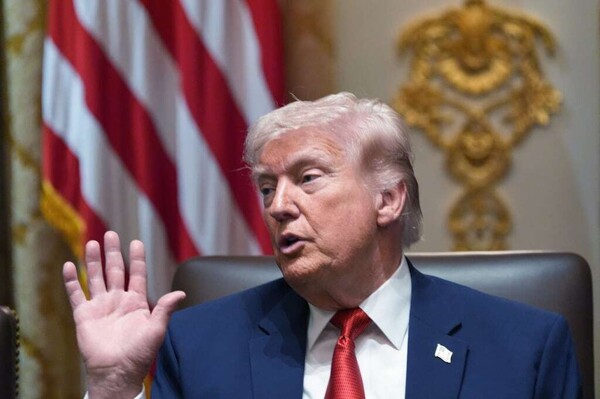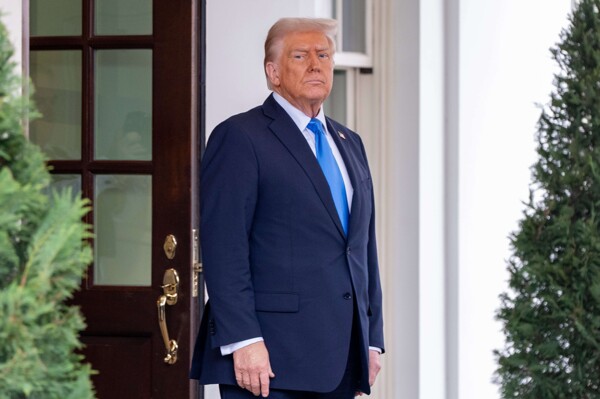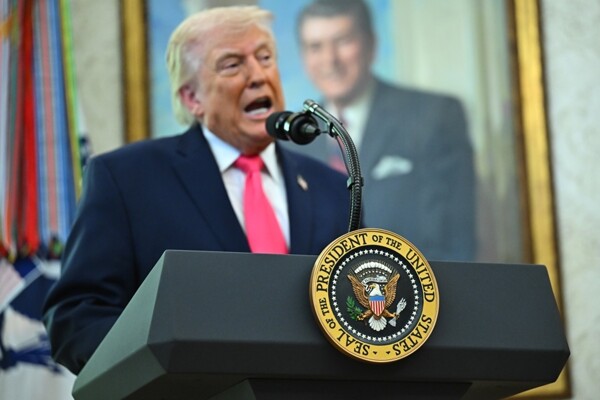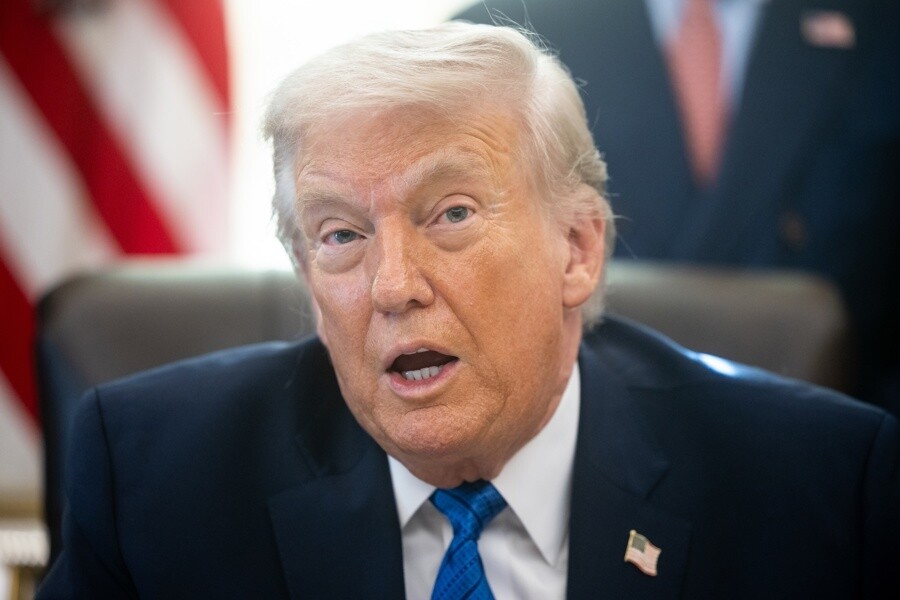
The President of the United States, Donald Trump, attended the Supreme Court session this Wednesday to debate the legality of his order to limit birthright citizenship, which the Republican wants to deny to children of undocumented parents or those with temporary visas. This is the first time a sitting U.S. president has attended oral arguments at the high court, which in June 2025 ruled in favor of Trump and lifted the blocks from lower courts on the controversial policy. The president arrived about ten minutes before the hearing began and took a seat in the first row of the public section in the courtroom. Trump listened silently with his hands clasped as the session began, a short distance from the lectern where Attorney General John Sauer is defending his administration's position. "If President Trump wants to come to the Supreme Court to watch the ACLU give him a lesson on the meaning of the Constitution and birthright citizenship, we would be delighted to sit with him in that same court," said Anthony D. Romero of the American Civil Liberties Union (ACLU). The executive director of the organization, which is supporting the lawsuit against Trump in the Supreme Court, said in a statement today that "any attempt to distract from the gravity and importance of this case will not succeed" and asserted that the court "is up to the task of interpreting and defending the Constitution, even under the watchful eye of a sitting president." "This is one of the most important cases of the last hundred years" in the United States, Romero insisted. Limiting automatic citizenship for the children of irregular migrants was one of the Republican leader's campaign promises, who returned to power more than a year ago with a hardened anti-immigration policy. The president signed the executive order on the same day he began his second term in January 2025, although it was immediately challenged in courts in several states. The Supreme Court's decision to hear arguments in this case means a review of a right enshrined in the 14th Amendment to the Constitution, which since the 19th century has guaranteed U.S. citizenship to people born in the territory. Trump has defended his position by saying that this legislation was passed after the Civil War (1861-1865) to protect "the children of slaves" and not for "those who take a vacation to obtain U.S. citizenship." Last June, the conservative majority of the court (6-3) sided with Trump in his request to lift the blocks issued by judges in Maryland, Washington, and Massachusetts, who in separate rulings determined that the president does not have the authority to change or restrict the Constitution. At that time, the Supreme Court did not rule on the constitutionality of Trump's executive order, but on the jurisdiction of lower courts and the legality of their decisions to nationally block an executive order. Legal experts, human rights advocates, and critics of the president have questioned this limitation, pointing out that birthright citizenship is a constitutional right that cannot be revoked by a presidential order. According to a study by the Migration Policy Institute, some 255,000 children a year could be affected if the Supreme Court sides with Trump and affirms the limitations on birthright citizenship. Although they did not attend sessions while in office, several presidents have been associated with the Supreme Court. Richard Nixon (1969-1974) argued a case before the court in 1967 between his terms as vice president and president, while William Howard Taft served as chief justice after his presidency (1909-1913).