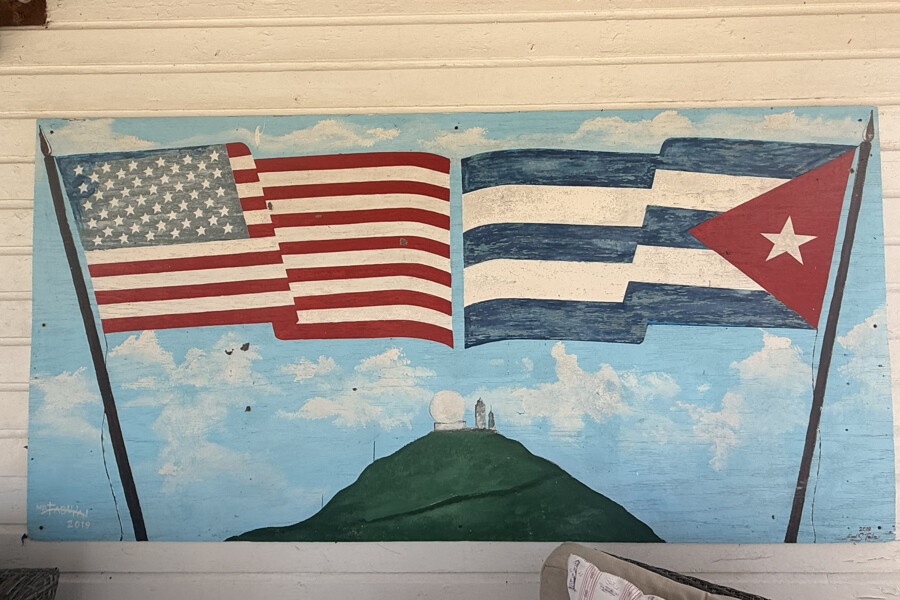
Welcome to… Cuba? Despite the signs on the military base fences welcoming you to 'Guantanamo Bay, Cuba,' it is very difficult for someone who has walked the streets of Cuba to reconcile images of old cars, trash in the corners, and neighborhoods in darkness with an Irish pub, a cinema showing the latest Hollywood blockbuster, or a McDonald's on the island's soil, which has been serving its famous hamburgers since 1986. At first glance, the connections between the two cultures are scarce, but the few that a keen eye can identify are evident: an altar to the Virgin of Charity of Cobre, Cuba's patron saint, streets named after independence war heroes like Jose Marti and Antonio Maceo, royal palms, or endemic iguanas and hutias. Currently, only a small number of Cubans, now very elderly and in fragile health, remain on the base from the more than 300 who used to work here decades ago and chose to stay as special residents. Five years ago, there was a community center with a cultural program to maintain island traditions. A small museum safeguards part of the controversial enclave's history, which has become an awkward legacy for the Cuban government, which considers it 'illegal' and demands its return, to which the United States has refused, citing a 1930s bilateral agreement that requires joint authorization for its return. A mural in the gift shop shows one of the few Cuban flags that can be seen on the base, where it is also uncommon to hear island music or find a 'complete' meal with congrí, roasted pork, yuca with mojo, and fried plantains, but you can get a Starbucks frappuccino or a protein smoothie after a workout at the gym. Photograph from March 22, 2026, showing images of President Teddy Roosevelt during his participation in the Spanish-American War of 1898, on display at the museum of the U.S. naval base in Guantanamo (Cuba). The century-old naval base that the United States maintains in southeastern Cuba, against the will of Havana, is separated from the rest of the Caribbean territory by more than just barbed wire and a strip of land that could still be mined. The territorial, ideological, and economic gap between the two countries, enemies for nearly 70 years, becomes palpable when you visit the U.S. military enclave, established in 1903, one of the oldest that the U.S. has outside its borders and the only one in a communist nation. On one side, a country plunged into a humanitarian crisis exacerbated by the recent crude oil blockade imposed by Washington, and on the other, a small portion of about 116 square kilometers with crowded markets that never turns off its lights or stops its cars for lack of fuel. While last weekend the rest of the Caribbean country experienced its second nationwide blackout in less than seven days, the daily scenes at the U.S. military base could—if you ignore the signs prohibiting photography and the military uniforms and buildings—be the same as in any neighborhood in nearby Florida. Photograph from March 22, 2026, showing images of the Spanish-American War of 1898, on display at the museum of the U.S. naval base in Guantanamo (Cuba). In 1961, he stopped cashing the $4,000 rent checks that Washington still pays for the base and cut off the water and supplies in 1964. From that moment on, 'Gitmo'—as the Americans call it—has been 'completely self-sufficient' and has 'its own sources of energy and water' that serve about 6,000 base residents, according to the U.S. government's military installations directory. Shipments of fuel and supplies arrive at the enclave, which has its own hospital and airport, and although it is more recently known for housing the alleged perpetrators of the September 11, 2001 terrorist attacks, it continues to be one of the U.S. Navy's strategic points in the Caribbean. EFE photo. The entrance. The U.S. base.