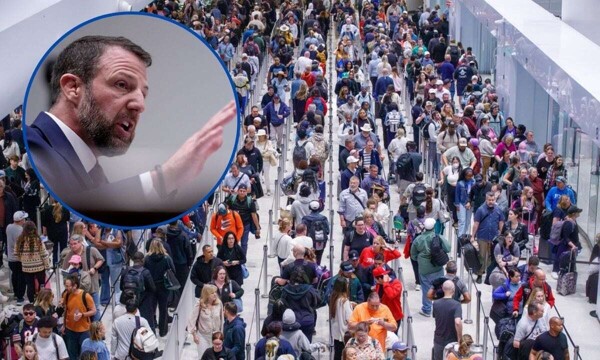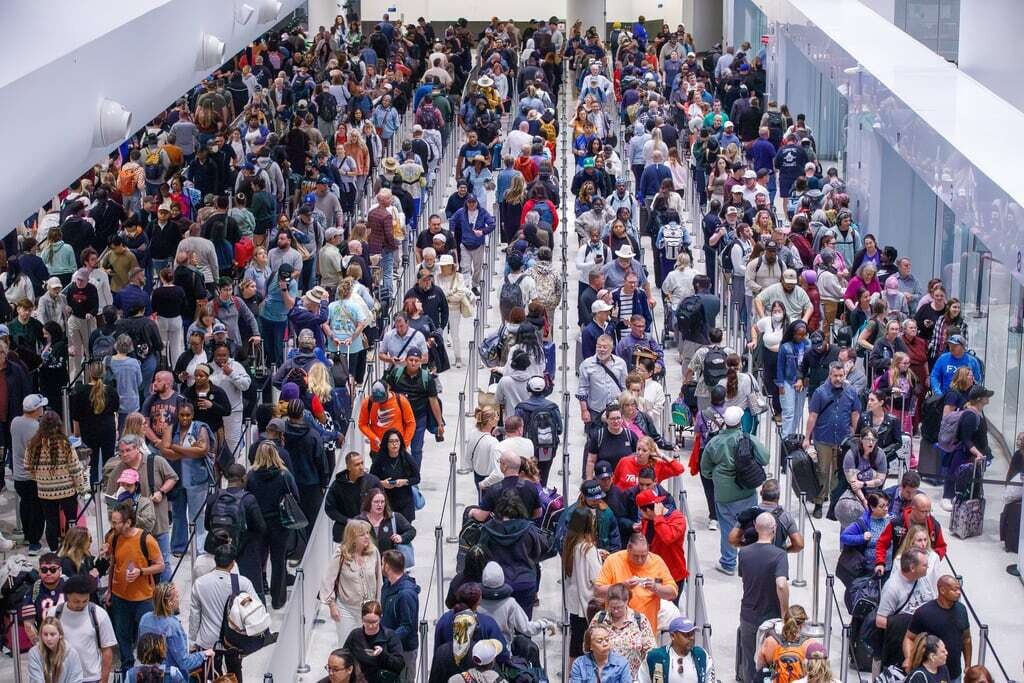
The deployment of Immigration and Customs Enforcement (ICE) agents at U.S. airports, promoted by President Trump to alleviate security checkpoint chaos, did not fundamentally solve the problem on its first day of implementation. Although agents were sent to 14 airports, long lines, delays, and uncertainty for passengers continued throughout the first day of the operation. The measure came amid a partial shutdown of the Department of Homeland Security, which left thousands of TSA employees working without pay. This crisis has already led to more than 400 resignations and a national absence rate of 11.76% on Sunday, March 22, according to DHS data revealed by CNN. What did ICE do in the airports? The main limitation of the plan is that ICE agents are not trained to conduct baggage checks, operate X-ray machines, or perform pat-downs, which are key TSA tasks. According to local media reports, their support focused on auxiliary tasks, such as managing lines, monitoring exits, and crowd control. This means ICE was able to help alleviate some congestion points, but it could not replace the specialized agents missing from the checkpoints, so analysts consider it an incomplete solution. Most congested airports. The biggest headaches remained concentrated in the same critical points as in previous days. The worst wait time was recorded at George Bush Intercontinental in Houston (IAH), at 220 minutes, far above the rest of the monitored airports, according to a CNN report. Behind it were JFK, Charlotte, Dallas-Fort Worth, and Orlando, although with less scandalous times. However, other reports also warn of serious gridlock in Houston and long lines in New York and San Juan. Regarding staff absenteeism, the airports with the most delicate figures are New Orleans, Atlanta, Houston, JFK, LaGuardia, Baltimore/Washington, Philadelphia, and Phoenix, with rates exceeding 40% in some cases. Were there any incidents? To date, no major incidents of violence or arrests caused by the ICE deployment in the airports have been recorded during that first day, which was what many people feared. What there was was discomfort, criticism, and tension among some passengers, especially in terminals in New York, Newark, and Atlanta, where there was a visible presence of agents and reactions from annoyed or distrustful travelers. For now, the lines at the airport terminals would not allow for talking about results in the implementation of the program promoted by President Trump; however, it was also not a total system collapse. Passenger testimonies indicate that on the first day there was limited relief that did not address the root of the problem, which is the lack of trained TSA personnel due to the budget shutdown. In cities like Philadelphia, the impact was moderate and the most extreme scenes of Houston or Atlanta were not repeated. For now, local media agree that the only real way out is to restore DHS funding and pay the TSA, because training new agents takes months and cannot be improvised with immigration personnel.