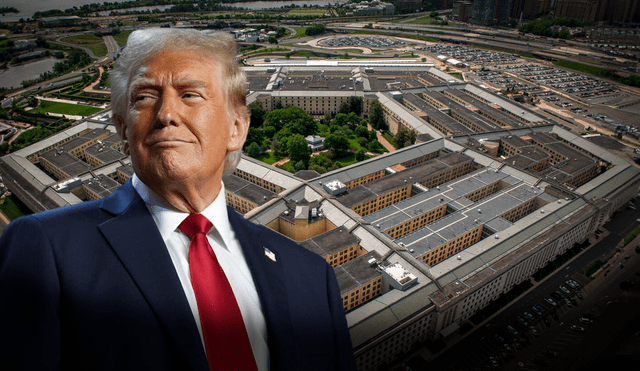
In the White House's view, this is not a blind adjustment, but a reallocation of funds, moving resources from what are considered inflated areas to defense, border security, police, veterans, and national security. As was to be expected, the budget has already sparked a Democratic reaction and opened another front of war in the Capitol. First the shield, then social governance. This sequence, which critics consider reckless, represents something different for its voters: the attempt to rebuild the United States as a feared and respected power, even if it means cutting domestic programs that for years have functioned as a political slush fund, a patronage apparatus, or a cultural trench for federal progressivism. The Russell Vought administration presented all this as a reinvestment in national security in a 'dangerous world,' making it clear that for Trump, military supremacy is no longer just another chapter in the budget: it is the heart of the budget. To finance this shift, the OMB proposes a 10% cut in discretionary spending not allocated to defense, equivalent to about $73 billion, and that is where the major political battle has already begun. On the other side, the ruling party argues that the real problem has been sustaining a hypertrophied federal structure for years—becoming ever more expensive and less efficient—while the international situation degraded. In the political language of Trumpism, the signal is unequivocal: in a world at war, with the Iran crisis open, the Strait of Hormuz under pressure, and the underlying competition with China, Washington does not intend to first debate subsidies, bureaucracy, or identity programs, but rather hard power, deterrence, and strategic muscle. The architecture of the plan confirms this logic. The war in Iran, the militarization of the Gulf, tensions with China, the industrial crisis, and the need to replenish arsenals are pushing the administration to demand a historical leap in defense, even at the cost of a high domestic political price. The key now lies in Congress, which must decide how much of this package survives intact and how much gets trimmed by legislative negotiation. First military power, then the conversation about the size of the state. For Trumpism, force comes first; the rest comes after. But beyond the final outcome, the message has already been sent. Trump chose to present a budget in the broadest sense as a war budget: not only for the record volume of funds for the Pentagon, but because it is based on a very clear, almost brutally frank, ideological premise. The opposition presented it as a 'morally broken' plan that privileges the military apparatus over health, education, and social assistance. The document also confirms that the Department of Education would continue to be 'on the path to elimination,' one of the most ideological banners of Trumpism, and proposes aggressive cuts to housing, health, climate change, foreign aid, and structures that the administration defines as 'woke,' redundant, or captured by the Washington bureaucratic left. The proposal for the fiscal year 2027 raises total defense spending to $1.5 trillion, a 44% jump from the current level, and makes it the largest military budget request in U.S. history. The adjustment heavily impacts emblematic areas of the federal state: Agriculture would fall by 19%, Commerce by 12.2%, Labor by 25.9%, the EPA by nearly 52%, and NASA by 23%. Washington - April 3, 2026 - Total News Agency - TNA - Donald Trump presented this Friday a budget that bluntly whitewashes what will be the priority of his second term in the White House: more defense, more security, and less domestic spending on programs his administration considers oversized, ideological, or directly unproductive. According to the White House document, the budget contemplates $1.1 trillion in base discretionary spending for the Department of Defense and another $350 billion in additional mandatory resources for critical administration priorities, including munitions, expansion of the military industrial base, missile defense, and shipbuilding. At that point, Trump's argument connects with a significant part of his base: if the United States intends to remain the decisive power on the planet, it cannot enter the new decade with the budgetary mindset of peacetime. It also includes a recomposition of military salaries, with differentiated raises reaching up to 7% for the lowest ranks, in addition to new investments in the Golden Dome system, submarines, ships, critical minerals, nuclear capability, and border surveillance.