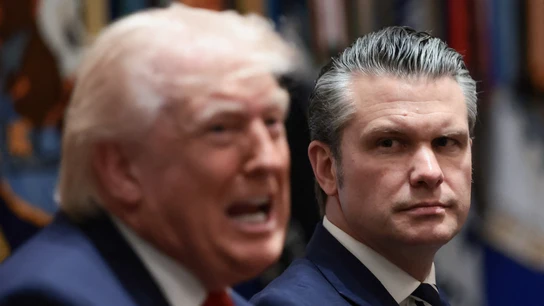
The definition was important because it diplomatically-militarily whitewashed what Trump had been shouting from the networks: that he does not want to lead the next stage alone. Hegseth also sought to sustain the narrative of military strength of the Republican administration. The war with Iran, open since the end of February, has already altered the global energy market, driven up crude oil prices and put pressure again on fuels in the United States. It is, in fact, an open pressure on European allies to put ships, military muscle and political decision where until now they preferred to move with prudence. The phrase, brutal even by the usual standards of the Republican, confirmed a change of tone that in Washington is already beginning to be read as more than just a bluff: the intention to transfer part of the weight of a war that has become longer, more expensive and much more uncomfortable than the White House imagined at the beginning to European allies. The most significant thing is that this line was reinforced almost immediately by the head of the Pentagon, Pete Hegseth, who spoke at a press conference and left a very concrete message: it is not only the task of the United States Navy to reopen Ormuz. For Trump, who needs to arrive in better condition for the November legislative elections, the combination of a prolonged war, expensive energy and hesitant allies is turning into a dangerous political cocktail. According to the official, Washington has already done "most of the work" to reduce the Iranian threat and now there are other countries that should prepare to intervene in that critical route. In a message full of reproaches, the president of the United States made it clear that, after leading the offensive against Iran together with Israel, he now expects others to take charge of the riskiest phase of the conflict: guaranteeing the reopening of the maritime route that Tehran keeps under pressure. The message was not subtle. Trump especially targeted the United Kingdom and France, two countries that he reproaches for not getting involved as he had wished in the military campaign. And that is where Hegseth's phrase comes in, which ended to order the play: for the White House, the initial heavy work was already done by the United States; what comes next, they suggest, should be shared by the rest of the Western bloc. That is why his message to Europe was not only a reproach: it was also a way to mark distance and establish that, if the strait remains blocked, the bill should not fall exclusively on Washington. The scene, in addition, leaves a powerful political conclusion. Trump initiated the offensive together with Israel under the logic of a rapid demonstration of force, but now he begins to insinuate that the reopening of Ormuz—the piece that would really order the energy board—can be left in the hands of others. In the same line, he pointed out that Iran practically has no margin to modify the course of events by military means. Washington, March 31, 2026 - Total News Agency - TNA. Donald Trump again strained to the maximum the relationship with his Western allies by demanding that they be the ones to assume the political and military cost of reopening the Strait of Ormuz, the key passage through which nearly a fifth of the oil and gas traded in the world circulates. He said that the days to come will be "decisive" and affirmed that the pressure on Iranian forces is deteriorating their morale, causing desertions and lack of key personnel. In his post, he told the countries that cannot get fuel due to the closure of Ormuz to buy American oil or to gather "belated courage", go to the strait and "take it". The warning sounded like a double message: on the one hand, a signal to Tehran to accept an agreement; on the other, a way to justify before the US public opinion that the campaign has advanced enough to begin to think about an exit or, at least, a transfer of responsibilities. Behind this verbal offensive there is a fact that worries the Republican administration more and more: the economic impact of the conflict. It is not a minor detail.