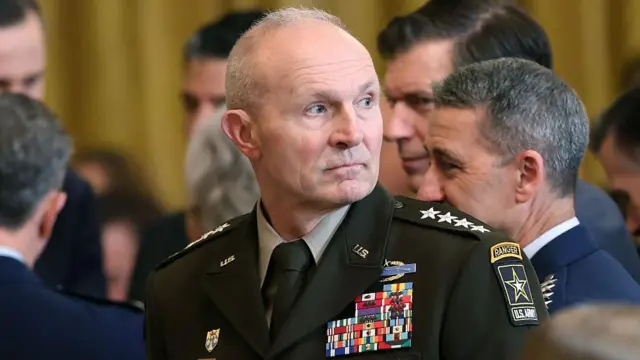
Washington, April 3, 2026 - Total News Agency - The removal of General Randy George as Chief of Staff of the United States Army was not presented by the Pentagon as a disciplinary measure or as a consequence of a specific incident. However, in Washington, no one read it as a simple administrative rotation. The general had been nominated by Joe Biden and confirmed by the Senate in 2023 for a term that, under normal circumstances, should have extended until 2027. Nevertheless, Hegseth demanded his immediate removal, a decision that came amid a military escalation in the Middle East and at a time of strong political intervention by the new civilian team over the military structure. Reuters and AP agreed that the Pentagon did not offer an official reason for the removal, but they framed it within a wave of purges that had already affected other military leaders since Hegseth took office. In fact, George's departure appears to fit three underlying motives. The first is political: the desire of Trump and Hegseth to surround themselves with commanders who not only obey, but actively share their doctrinal redesign of the Army. That is why the replacement of George by LaNeve should not be read as a technical change. The administration is making it clear that it does not want just combat experience or impeccable resumes, but commanders who will accompany, without nuances, a stage of greater external confrontation and strong political centralization within the defense apparatus. It is, above all, a power message: in the new Pentagon era, strategic and political loyalty seems to weigh as much as a military career. Sources cited by CBS News pointed out that the head of the Pentagon was looking for someone who would execute without deviation “the vision” of this administration for the armed forces, while spokesperson Sean Parnell made that line clear by praising the interim replacement, General Christopher LaNeve, as a man of full confidence to carry out that orientation “without flaws”. The key, then, is not a personal shortcoming of George, but the type of military leadership that the Republican administration wants to install. The second is bureaucratic and ideological: several of the officers displaced in recent months were associated with the previous stage or with modernization and diversity programs that the new Secretary of Defense is questioning harshly. The departure, ordered by Defense Secretary Pete Hegseth, responded to the political objective of placing at the head of the Army a commander more identified with the vision of Donald Trump and Hegseth himself, amid a much broader restructuring of the US military leadership. These reports indicate that the tension between civilian leadership and part of the high command had been growing around the anti-DEI agenda promoted by Hegseth, who has made the fight against what he calls “wokeness” within the armed forces one of his central banners. Although the formal reason for the dismissal was not specified, the dominant reading in Washington is that George fell into the same logic that had already affected other high-ranking officers: not being considered sufficiently aligned with the new political creed of the Pentagon. The most sensitive point is that this move occurs while the United States is expanding its military involvement in the war against Iran. And the third is internal control: Hegseth seeks to consolidate authority over an institution that traditionally moves with its own times, balances, and rules, and which is now being pushed to adapt to a more political and less autonomous logic. To this picture are added versions still not officially confirmed, but already circulating strongly in US media, about recent clashes over military promotions and the handling of officer promotion lists. In that context, removing the head of the Army and two other heavyweight generals does not look like a mere personnel adjustment, but rather as a signal of disciplining in time of war. Quoted text: “Sources cited by CBS News pointed out precisely that the head of the Pentagon was looking for someone who would execute without deviation “the vision” of this administration for the armed forces, while spokesperson Sean Parnell made that line clear by praising the interim replacement, General Christopher LaNeve, as a man of full confidence to carry out that orientation “without flaws”.”