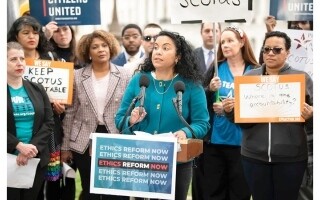
In the past, U.S. party primaries rarely garnered much attention, and internal political competitions tended to be so boring that only about one in five eligible voters bothered to cast their ballots. With the first elections of 2026 less than two weeks away, this season's primaries are shaping up to be boisterous and crowded, reflecting tensions within both the Republican and Democratic parties. It's an unprecedented situation in modern memory, and already, nine U.S. senators and more than 50 members of the House of Representatives—a 21st-century record—are retiring or running for higher office, opening opportunities for many contenders across the country. Added to this are the high stakes of controlling Congress, voter discontent, and the likelihood that the president's party will suffer losses as it typically does in midterm elections, attracting both seasoned politicians and compelling newcomers from all walks of life. "An environment like this pushes a lot of people to think about running," said Nathan Gonzalez, director of the nonpartisan election analysis site Inside Elections, adding, "They're thinking, why not me?". A slim edge Democrats need only a slim edge to win control of the House of Representatives, where they are four seats short of Republicans, with three vacancies. Retaking control of the Senate is a tougher task, requiring them to win four seats. This year's map suggests they will mostly be playing defense on the seats they hold. This year's elections will be close. Looking at the number of districts and states safely in one party's hands, the vast majority of congressional races will effectively be decided when the winner of the primary is chosen. According to the Cook Political Report, only 18 of the 435 House races and four of the 35 Senate seats this year are considered truly competitive in November 2026. "More than ever, primaries will shape the character and makeup of the next Congress," said Nick Troiano, executive director of the nonpartisan Unite America, which seeks to break the two-party stranglehold on elections via open primaries. "For people's voices to be heard, primaries are everything.". The narrow slice According to a new analysis of 2024 voter data by Unite America's research division, the narrow slice of voters who typically vote in primaries does not perfectly represent voters overall. While most general election voters consider themselves independents and moderates, those who vote in primaries are more ideological and partisan, as well as older, wealthier, and mostly white. But the sheer number of hotly contested races this year may give more voters a reason to participate. An example is the recent Democratic primary in New Jersey's 11th congressional district, where 11 candidates vied in a special election to fill a House seat vacated by new Gov. Mickey Sherrill. The race featured candidates from across the party's ideological spectrum, attracted millions in outside spending, and resulted in a razor-thin victory for progressive politician Analia Mejia. The test As the primary season unfolds, it will become clear whether Democrats, as a whole, are tilting left or toward the center, and whether they vote with emotion or pragmatism. The Republican primaries will test candidates on various issues, including whether President Donald Trump's endorsement remains a "magic wand" or if Republican voters have grown more wary of his agenda.