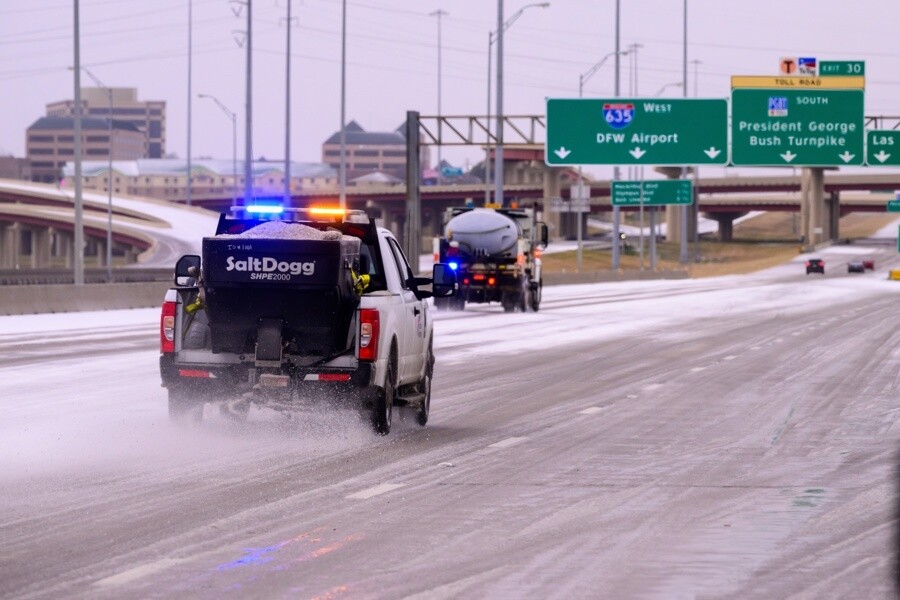
More than two dozen states in the central, southern, and eastern United States activated emergency protocols this Saturday due to a massive front bringing extreme cold, significant sleet, and snowfall. Combined with the low temperatures expected in the coming days, this raises concerns for critical infrastructure. The major winter storm affecting two-thirds of the country is moving eastward. States like Oklahoma, Kansas, Arkansas, and Texas are already severely impacted by snow and sleet, which is expected to soon hit areas further east, including the nation's most populous city, New York. Over 47,000 homes are without electricity in Texas and 52,000 in Louisiana, according to the specialized website poweroutage.us. Flight-tracking portals also show thousands of flight cancellations, around 4,000 today and more than 8,000 for tomorrow Sunday. The front is expected to reach the Mid-Atlantic region with significant snowfall early Sunday morning, affecting states like New York, New Jersey, Pennsylvania, Delaware, Maryland, West Virginia, Virginia, as well as the capital, Washington, D.C., and the Southeast states of North and South Carolina. Throughout Sunday, the storm, caused by an extended or displaced polar vortex, will move northwest toward the New England region. Heavy Snow and Cold The National Weather Service sees possible snow and ice accumulations in New York between 7 and 11 inches (17 and 27 centimeters) with lows of 15 degrees Fahrenheit (-9 degrees Celsius), while in cities like Baltimore, Philadelphia, or Washington, less precipitation and slightly milder temperatures are expected. However, temperatures are expected to drop even further after the front passes, with projected lows in New York between Monday and Wednesday of 4 degrees Fahrenheit (-15 degrees Celsius). This situation is of particular concern due to the possibility of roads and other critical communications and services being disabled by ice. Many school districts in the southern part of the country have already announced there will be no classes on Monday, and it has also been announced that federal offices in Washington D.C. will be closed. “In the coming days, this storm will bring heavy snow, dangerous freezing rain, ice, and extreme cold that will put lives in danger,” said Homeland Security Secretary Kristi Noem at a press conference today, assuring that the adverse conditions “will last for several days.” Power Outages “Power outages, road closures, and other effects are already impacting the Midwest, the South, and the East Coast,” she stated. “We are working with our energy companies and rural electric communities to ensure we can facilitate repairs to the grid as soon as possible and restore power, especially given the low temperatures expected for the coming days,” Noem added. Meanwhile, President Donald Trump wrote on social media that he has approved federal emergency declarations for Tennessee, Georgia, North Carolina, Maryland, Arkansas, Kentucky, Louisiana, Mississippi, Indiana, and West Virginia. Both he and Noem emphasized that the U.S. federal government is cooperating with the Federal Emergency Management Agency (FEMA) and the states to ensure safety. The Homeland Security Secretary explained that she has activated the National Coordination Response Center in Washington for two days and that FEMA has already prepared emergency supplies at various points across the country. One of the most pressing concerns is the loss of power supply due to precipitation amid the intense cold spell looming over much of the United States.