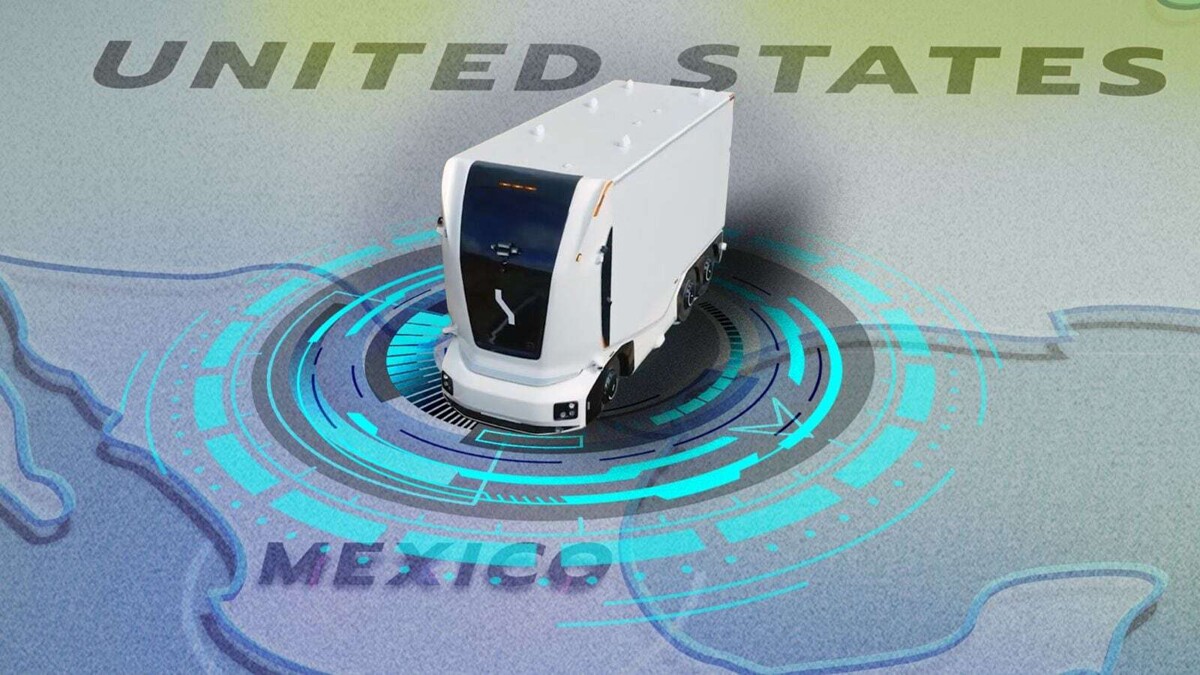
Texas functions as a linchpin... and now also as a laboratory. The logic is clear: less urban traffic, long routes, and relatively controlled conditions make these roads the perfect scenario for autonomy. For Mexico, the advancement of driverless trucks is not just a technological curiosity. A critical part of Mexican exports passes through here, turning this corridor into ideal terrain for testing technologies aimed at accelerating logistics. From Laredo to Dallas-Fort Worth or El Paso, autonomous trucks are beginning to be integrated into long, repetitive, and highly trafficked routes. While insecurity in Mexico increases transportation costs and forces companies to secure their routes, on Texas highways, a person monitors the journey while sensors and algorithms push forward. Autonomous trucks are already circulating in key corridors connecting the Mexico-US border, moving real goods, for real customers, and under real conditions. As trade between Mexico and the US reaches historic levels, a new variable is added to the equation: cargo transport that doesn't sleep. Thousands of truckers could be affected in the long term, opening a debate about labor retraining and the future of work in the sector. The future of freight transport in Mexico and the US: this is just the beginning. What is observed in Texas today is merely the first act of a broader transformation. Companies are already planning to scale operations, eliminate safety drivers, and expand routes to new corridors. What happens on Texas roads doesn't just redefine transportation in the US; it could also alter the speed, cost, and logic of Mexican foreign trade. Autonomous trucks in Texas: Which companies are already operating on commercial routes? The advancement of autonomous trucks in Texas already has specific names. Companies project scaling from dozens to hundreds of units in the short term and reaching thousands by 2027. The deployment is not random. Unlike human operators, these vehicles can operate practically without rest, reducing transit times from the Mexico-US border to distribution centers. This could translate to: Faster deliveries, Lower logistics costs, Greater competitiveness for Mexican exporters. In a context where efficiency defines supply chains, every hour counts. And if a truck can move all night without pauses, the advantage becomes tangible. Furthermore, the trucking industry faces a structural deficit of operators in both Mexico and the US. In this scenario, autonomous trucks could become a central piece of trade in North America. For Mexico, the challenge will be to adapt to this new rhythm without losing competitiveness. Texas is home to some of the most strategic routes for trade in North America. Laredo, in particular, is the nerve center of trade between Mexico and the US. A group of technology and logistics companies has already deployed fleets promising to reduce times, costs, and end the driver shortage. The change is not minor. Routes like Houston-Dallas are also highlighted, where companies like Bot Auto already operate constantly. Additionally, the corridor connecting Fort Worth with El Paso is part of one of the most important transportation routes in the US, linking the east and west coasts. The border will not only mark the limit between countries but also between logistical models: one that rests... and one that never stops. While some trucks wait for their drivers to rest before getting back on the road, others are already moving without pause, guided by code, and all indications are that they are not going to slow down. A 20-ton trailer advances on the highway with no one touching the steering wheel. Without a steering wheel or space for a driver, these vehicles are designed from scratch to maximize efficiency and payload. Although many of these trucks still include safety drivers, the next step is already underway: to completely eliminate human intervention. On the other hand, continuous operation would allow for route optimization and reduced downtime. Kodiak AI collaborates with logistics giants like JB Hunt and Werner Enterprises, while Bot Auto makes trips between Houston and Dallas-Fort Worth, even at night. One of the most disruptive cases of autonomous trucks in Texas is that of Einride, the Swedish startup that operates completely autonomous electric trucks without a cabin. The integration of this technology will also depend on regulations, infrastructure, and binational coordination. Advantages and risks: efficiency, costs, and the fear for employment. The discourse in favor of autonomous trucks is based on three pillars: efficiency, safety, and costs. On the one hand, the elimination of human fatigue could reduce accidents. Companies like Aurora, Kodiak AI, Einride, and Bot Auto have moved from controlled tests to commercial operations on open roads. Aurora, for example, already transports goods for companies like Hirschbach and Driscoll’s on active routes. This is a factor that can directly impact Mexico's main economic engine: trade with the US. The central promise is simple: 24/7 operation. Automation appears as a solution to that bottleneck. However, the impact will not be uniform. Furthermore, public acceptance is still under construction: not everyone is comfortable with the idea of 20-ton trucks circulating without a driver. The biggest point of tension is employment. However, the advancement is not without shadows. Technical problems such as 'phantom braking'—when sensors detect non-existent obstacles—generate concern. The scene occurs at night.