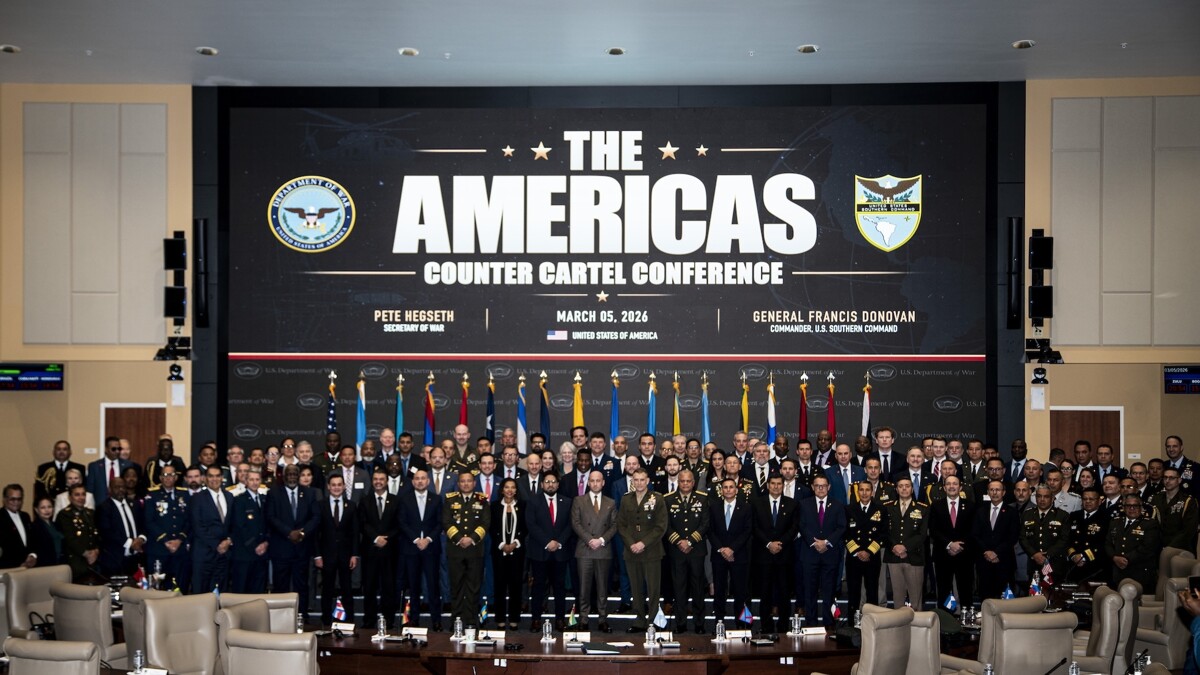
The Conference against the Cartels of the Americas, held on March 5 at the headquarters of the United States Southern Command (SOUTHCOM) in Doral, sent a high-impact political and operational signal for the entire hemisphere: the United States and 17 other countries signed a joint security declaration to expand cooperation against narcoterrorist networks, strengthen border control, and deepen regional coordination in the face of a threat that Washington now treats not just as organized crime, but also as a national security and terrorism issue. The tone of the meeting was deliberately tough. This shift in legal and political framing is key to understanding the spirit of the Doral conference: the underlying message is that the fight against cartels will no longer be presented solely as a law enforcement pursuit, but as a hemispheric security campaign. In this context, SOUTHCOM's commander, General Francis L. Donovan, was even more direct. For the governments of the hemisphere, this implies acknowledging that the problem of cartels has ceased to be a local or police matter and has become a regional strategic challenge. Argentina's participation in a conference of this profile reflects a clear alignment with the new hemispheric agenda driven by Washington, especially at a time when the government of Javier Milei is toughening its rhetoric against drug trafficking, transnational crime, and the convergence of criminal organizations with political or financial support networks. Alongside Argentina, delegations from Bahamas, Belize, Bolivia, Chile, Costa Rica, Ecuador, El Salvador, Guatemala, Guyana, Honduras, Jamaica, Panama, Paraguay, Peru, Dominican Republic, and Trinidad and Tobago participated, as well as U.S. officials. From Ecuador, Guatemala, Panama, Peru, Dominican Republic, Costa Rica, Honduras, and other countries, a central idea was repeated: cartels should no longer be seen as mere mafias dedicated to moving narcotics, but as structures that erode sovereignty, infiltrate institutions, use technology, exploit state vacuums, and threaten democratic stability. He stated that cartels and drug traffickers are carrying out “campaigns of terror, violence, and corruption” to expand their regional influence, and defined this activity as the most serious threat to the hemisphere's security. But it became clear that the conference against the cartels of the Americas was not presented as a minor diplomatic gesture, but as the beginning of a tougher stage in hemispheric security policy. One of the most relevant points of the event was the signing of the Joint Security Declaration, subscribed in Doral between March 4 and 5. The declaration was not written in vague terms: it sets out a roadmap pointing to coordinated operations, greater intelligence sharing, and a 'whole-of-government' approach to transnational criminal networks. Argentina's participation was one of the highlighted aspects for the regional projection of the meeting. The document reaffirms defense and security ties between the participating countries and commits to cooperation in border security, combating narcoterrorism and illicit trafficking, protecting critical infrastructure, interoperability between agencies, and a hemispheric coalition to face shared threats. This definition aligns with the vision of the Trump administration, which associates drug trafficking, irregular migration, weapons, human trafficking, and organized crime within the same threat matrix. In his speech, he stated that the meeting was the first of its kind led by a Secretary of War in over 30 years and emphasized that the priority of the Donald Trump administration is to make border security and the fight against cartels a central axis of the hemispheric agenda. It also shows to what extent transnational crime has become a governance problem for numerous states in the region. Another outstanding point of the meeting was the emphasis on border and maritime security. Joseph Humire, Acting Under Secretary of War for National Defense and the Americas, stated that without border control, there is no possible country, and that deterrence must be at the center of the hemispheric strategy. For the criminal organizations themselves, the signal was that the United States wants to build an offensive coalition, with political and operational support, to degrade them more coordinated. In many countries in the hemisphere, this observation touches a particularly sensitive nerve, as it refers to port areas, jungle corridors, border crossings, and urban neighborhoods where the state has been losing effective presence. The working sessions following the declaration's signing focused on practical cooperation: intelligence exchange, border security, maritime control, operational coordination, and strengthening regional capabilities to dismantle narcoterrorist organizations. For SOUTHCOM, the key is not just more resources, but to get countries to share information, synchronize procedures, and act in a combined manner against networks that operate without respecting national jurisdictions. The warning that came out of Doral was, in the end, double. That phrase summarizes with starkness the new U.S. approach: the problem is no longer measured just by tons of drugs or arrests, but by territorial control capacity and the challenge to the state's monopoly on the use of force. Overall, the conference brought together a wide arc of Caribbean, Central American, and South American countries, showing that SOUTHCOM's approach is not limited to Mexico or the Central American corridor, but seeks to consolidate a continental security network. The interventions of several regional ministers and security officials were in the same direction. Lieutenant General Carlos Alberto Presti, Secretary of Defense, reaffirmed that the states of the continent face similar threats that affect citizens, strategic resources, and critical infrastructure. The shift is based on a previous White House decision: on January 20, 2025, Trump signed an executive order to begin the process of designating certain international cartels and other organizations as Foreign Terrorist Organizations (FTOs) and Specially Designated Global Terrorists (SDGTs). From Washington's perspective, the threat is not limited to drug trafficking: it includes state infiltration, territorial control, convergence with extra-hemispheric actors, and methods typical of insurgencies and asymmetric warfare. That definition did not appear in a vacuum. How much of that ambition will translate into concrete results will depend on the real will of the countries, their internal capabilities, and their willingness to share sensitive intelligence. The White House's Deputy Chief of Staff, Stephen Miller, stated that no nation should tolerate a single square kilometer of territory under the control of cartels or terrorist organizations. In other words, the conference sought to consolidate a comprehensive reading of the problem, where land borders, maritime corridors, airspace, and cyberspace appear as connected theaters. The political dimension of the message also weighed heavily. A month later, the State Department formalized the designation of groups like the Sinaloa Cartel, the Jalisco New Generation Cartel, the Gulf Cartel, the Northeast Cartel, United Cartels, The New Michoacan Family, as well as the Aragua Train and MS-13. That coincidence is important because it reveals a shared diagnosis that goes beyond Washington's rhetoric. Therein lay one of the most important elements of the conference: it was not just about toughening the discourse, but about pushing concrete interoperability mechanisms. U.S. Secretary of War Pete Hegseth made it clear that this was not a ceremonial summit or just another diplomatic photo, but a meeting designed to advance concrete objectives with an action-oriented logic.