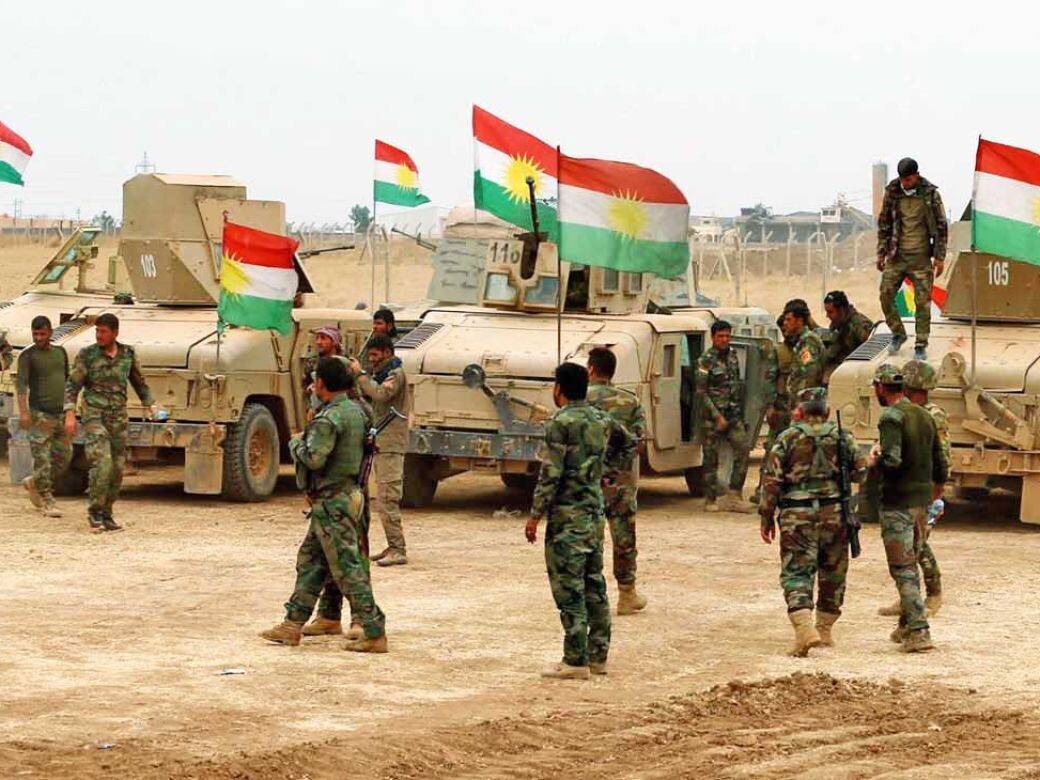
The withdrawal of US troops from northern Syria in 2019 was widely described as a betrayal of the Kurds, even by Western critics and allies, as it left these militias exposed to the Turkish advance and forced them to retreat and seek emergency accommodations with other regional actors. In the Iranian case, estimates of their demographic weight vary, but they constitute a relevant minority in the west of the country, with a long history of repression, cultural limitations, political persecution, and insurgent activity. Therein lies the great paradox of the plan some imagine in Washington: the Kurds could be useful for weakening the ayatollahs, but they could also become one of the vectors of a much broader and more unpredictable crisis. Ultimately, the Kurdish role in a possible collapse of the Iranian regime appears as a strong card, but one loaded with memory, caution, and risk. In Syria, Kurdish militias and later the Syrian Democratic Forces (SDF) were Washington's main local partner in the war against ISIS. For many Kurds, that episode was etched as an early lesson: their cause can be useful to a power, but it is rarely defended to the end. That is why the idea that the Kurds could be the infantry to complete the work that American and Israeli aviation cannot resolve on its own faces a major political and emotional barrier. In recent weeks, and according to intelligence sources and regional leaders cited by the international press, Iranian Kurdish groups explored with the United States the possibility of receiving support, even in terms of weapons or CIA assistance, for a eventual incursion. This reality makes the Iranian Kurdish regions a particularly sensitive area if the central power in Tehran weakens. But that scenario, which in Washington could be read as a tactical opportunity, is far from linear: for the Kurds, every American invitation to combat comes with a too well-known memory: that of being useful in war and dispensable in peace. The Kurdish people, dispersed between Turkey, Iraq, Syria, and Iran, have dragged for a century the condition of a stateless nation. In 1975, after the Algiers Agreement between Iran and Iraq, the clandestine support that kept the Iraqi Kurdish rebellion alive was abruptly cut as part of a geopolitical reordering. And they learned that the promises of the great powers usually last less than the wars they ask them to fight. Their role was decisive in milestones that marked the retreat of the caliphate: the resistance in Kobani, which became a symbol of the fight against extremism; the campaign on Raqqa, the de facto capital of the Islamic State; and finally, the fall of Baghouz in 2019, when US-backed forces announced the elimination of the group's last territorial enclave. That same year, after more than a decade of military cooperation with the United States, Syrian Kurds saw Washington back an agreement to reintegrate areas under Kurdish control to the Syrian central power, while the new correlation of forces in the country was leaving them increasingly cornered. Amid the US and Israel offensive against Iran, one of the hypotheses that generates the most anxiety in the Middle East is the possibility that the Kurdish front will be reactivated as a ground force of attrition against the ayatollahs' regime. If the Iranian regime weakens severely, Kurdish prominence would not necessarily lead to an orderly transition. Iran is a complex mosaic of Persians, Azerbaijanis, Kurds, Arabs, Baluchis, and other groups with their own claims. Syrian Kurdish leaders have already publicly warned their Iranian counterparts not to launch an operation without firm, clear, and written commitments from the United States. For now, there is no public confirmation of a final decision or a closed operational commitment. American interest in the Kurds does not come out of nowhere. From the Kurdish perspective, the message was brutally familiar: they are summoned when they are needed, and they are relegated when the strategic priority changes. And if the historical perspective is broadened, Kurdish distrust of Washington has even deeper roots. In this context, the Kurdish factor could be decisive, but not necessarily stabilizing. That campaign cost thousands of Kurdish lives and consolidated the idea that without them, the territorial defeat of ISIS would have been much slower and more costly. But the problem for any American plan in Iran is that the same experience left a bitter mark. According to recent reports, Iranian Kurdish militias based in Iraqi Kurdistan held talks with US officials about a possible operation in western Iran to hit security forces and open space for an internal uprising. The wound did not heal. The feeling of abandonment does not belong only to 2019. In 2019, Donald Trump's decision to withdraw troops from northern Syria opened the door to Turkey's offensive against Kurdish forces that had until then been Washington's central allies. The fear is simple to understand: to engage in open combat against Tehran and then be left to their own fate would be for them to repeat the worst part of a too well-known history. Strategically, the bet also entails a greater risk. They fought ISIS when almost no one wanted to put bodies on the ground. A collapse of the center could activate autonomous impulses, ethnic clashes, and territorial fragmentation capable of turning the regime's fall into a prolonged civil war. This experience explains why today, in the face of the new implicit call from the United States, they look at the map with interest, but also with a distrust that is not ideological: it is historical. By RR Washington - March 13, 2026 - Total News Agency - TNA -. Reports from early 2026 also indicated that, amid attacks on prisons holding thousands of ISIS detainees, Kurdish forces denounced that the US-led coalition did not intervene despite their requests for help. They paid a very high price.