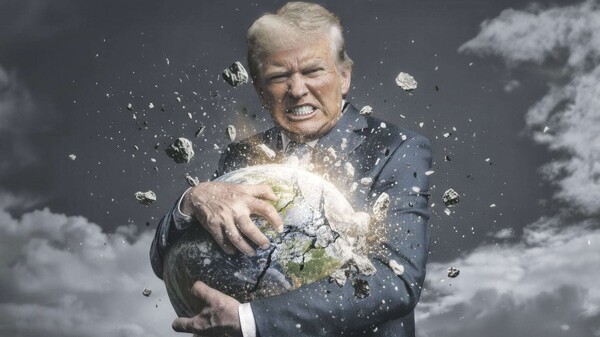
The European Union (EU) has reacted to the tariff chaos unleashed a year ago by Donald Trump by accelerating its search for new partners and modifying the trade pact initially reached between Brussels and Washington to include a clause against new attempts at blackmail.
The current picture of the trade relations of the Twenty-Seven with the United States and other international partners is very different from that of a year ago, when the US president, Donald Trump, launched his strategy of 'reciprocal tariffs' against the world.
Collapse of the European surplus Trump announced on April 2, 2025, a 20% tariff on almost all EU exports, double the universal 10% applied to other countries.
In the first quarter of that year, the EU's trade surplus with the world's leading power exceeded 80,000 million euros—a balance derived from 'unfair' trading practices, according to the Republican leader—and accounted for nearly 20% of the bloc's sales abroad.
Since then, and after months of trade war and tariff fluctuations on both sides of the Atlantic, the European surplus has been declining to stand at 31,000 million euros in the last quarter of 2025.
New trade framework with a shield for the EU Last Thursday, the European Parliament decided to shield the Union's interests in its exchanges with the United States by opting for the introduction of protective clauses against possible new tariffs or blackmail from the White House.
With that decision, the European Parliament put an end to three months of tension after the MEPs had twice halted the processing of the agreement, the first time due to Trump's threats to take over Greenland and impose higher tariffs on European countries that reinforced their military presence on the Arctic island, and the second time due to the Supreme Court's ruling that annulled most of the Republican's tariffs.
The processing by the European legislative body will allow the full application of the trade agreement reached last July, which set a maximum rate of 15% on most European imports and eliminate EU tariffs on US industrial goods.
In addition to what was initially agreed between Trump and the President of the European Commission, Ursula von der Leyen, the MEPs have added new clauses that allow the EU to suspend the pact if Washington introduces new tariffs or questions European territorial integrity, among other provisions.
Opening to Latin America and Asia-Pacific In recent months, the EU has managed to seal its historic free trade agreement with Mercosur, which after 26 years of negotiations will allow one of the largest integrated zones in the world.
The trade agreement will begin to be provisionally applied in May pending a ruling from the Court of Justice of the EU, an instance against which the European Parliament has appealed it.
In addition, the bloc recently closed a new trade pact with Australia after a decade of contacts, concluded its negotiations with India for what will be 'the mother of all agreements,' according to both parties, and reached another one with Indonesia last September.
'These agreements are significant because, although they are not the countries with which the EU trades the most, they stand out for their high population and economic growth expectations,' said EFE Pedro Aznar, professor of Economics and Finance at Esade.
The expert highlighted in particular the agreement with Mercosur after its long and complex negotiation and that of India, which gives commercial access to the world's most populous country despite being 'a complicated and highly regulated market'.
Although he considers it necessary to 'give time' to these agreements, the academic believes that the EU's efforts are 'necessary but not sufficient' to compensate for the 28% drop in its exports to the US during the last year, and despite the increase in exchanges with other partners.
Asked about a possible commercial rapprochement with China by the Union, something that countries like Germany or France have sought at a bilateral level, Aznar said that it is a 'delicate' option in which Brussels tries to find a balance between strengthening ties with the world's second-largest economy within the respect for trade rules, and at the same time avoiding a greater penalty from Washington.