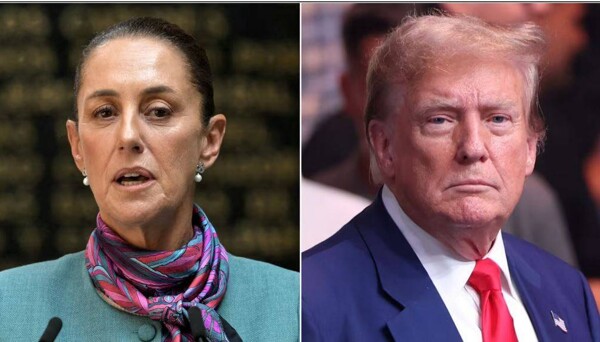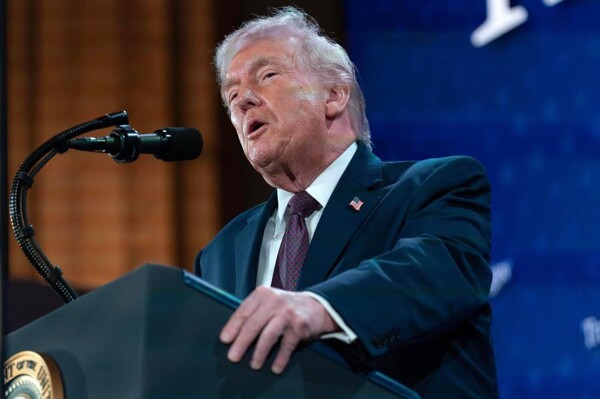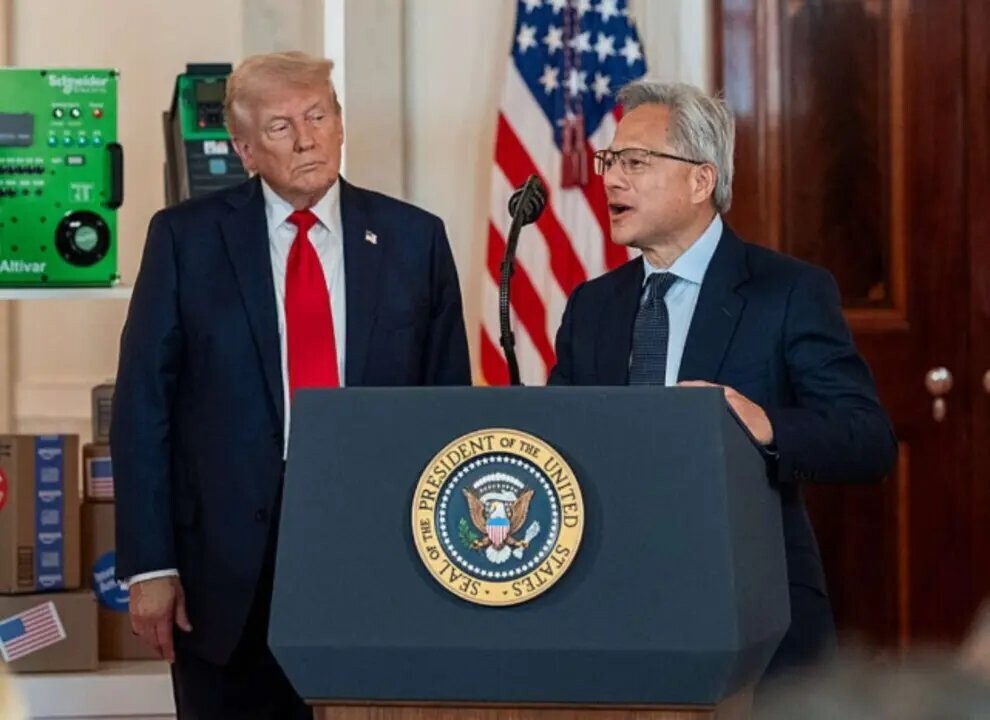
President Donald Trump has decided to allow the export of advanced artificial intelligence chips to China under strict national security conditions. This decision followed a meeting between Trump and Nvidia CEO Jensen Huang and was extended to competitors like Intel, AMD, and "other major US companies." The initial market reaction reflected uncertainty: shares of major US chip manufacturers fell after President Donald Trump's announcement to allow chip exports to China. Nvidia shares fell by about 0.4% to around $184.60 shortly after the market opened on Tuesday, after having risen 1.7% the previous day. AMD shares fell 0.7% to approximately $219.50, while Intel shares rose by about 0.3%. The President stated on his Truth Social platform that he informed President Xi Jinping that the United States will allow Nvidia to send its H200 products to approved customers in China and other countries, under conditions that guarantee strong national security. The H200 is the second most advanced artificial intelligence chip in Nvidia's Hopper GPU family for data centers, used to train and run AI models. Previously, restrictions imposed by the Joe Biden administration—and ratified during Trump's first months in office—limited the export of the H200 to China. A few months ago, Nvidia had managed to get the ban on the lower H20 chip lifted after a first meeting with Trump. At that time, a precedent was set to transfer 15% of the revenue to the country, a figure that now scales up to 25% for the most powerful hardware. In response, Nvidia designed reduced versions of the chips, the H800 and H20, but their shipments were also blocked. In August, the US Government began granting licenses for Nvidia to export the H20 chips to China. However, the Chinese government warned its companies not to use them to foster its domestic industry. China's Cyberspace Administration (CAC) even investigated the H20 for backdoors, creating a climate of distrust that the previous July agreement failed to fully dispel. Nvidia CEO Jensen Huang acknowledged during the company's GPU Technology Conference in October: "China prevented us from shipping to China. They made it very clear that they don't want Nvidia to be there at this time." In his post, Trump referred to the H20 chip and stated: "The Biden administration forced our major companies to spend billions of dollars creating 'degraded' products that nobody wanted, a terrible idea that slowed innovation and harmed the American worker." Now, with the more advanced H200 chip available for export, it is still unclear if China will authorize its companies to buy from Nvidia again. It was Huang himself who had warned about the danger of an 'AI Silk Road' if the US continued to block sales, and with this deal, he secured a golden opportunity not to lose a market that represents 13% of his revenue, although his Chinese customers now have to pay the price of American geopolitics. Trump also indicated that the US government will take a 25% cut on the sales of these chips, a higher percentage than the 15% applied to H20 exports. "This policy will foster American employment, strengthen the American manufacturing industry, and benefit American taxpayers," the President wrote. Advisors like David Sacks interpreted that the United States seeks to keep China dependent on its technology: a total blockade would force them to seek their own alternatives. In this sense, Huawei has already admitted that it would take two years to match the performance of the H200, making this chip the perfect tool to curb Chinese development while monetizing its need.