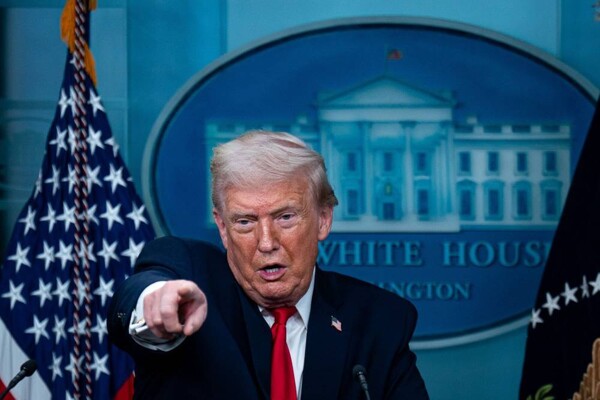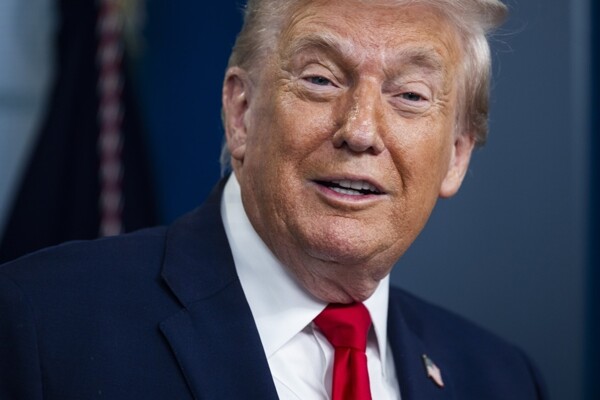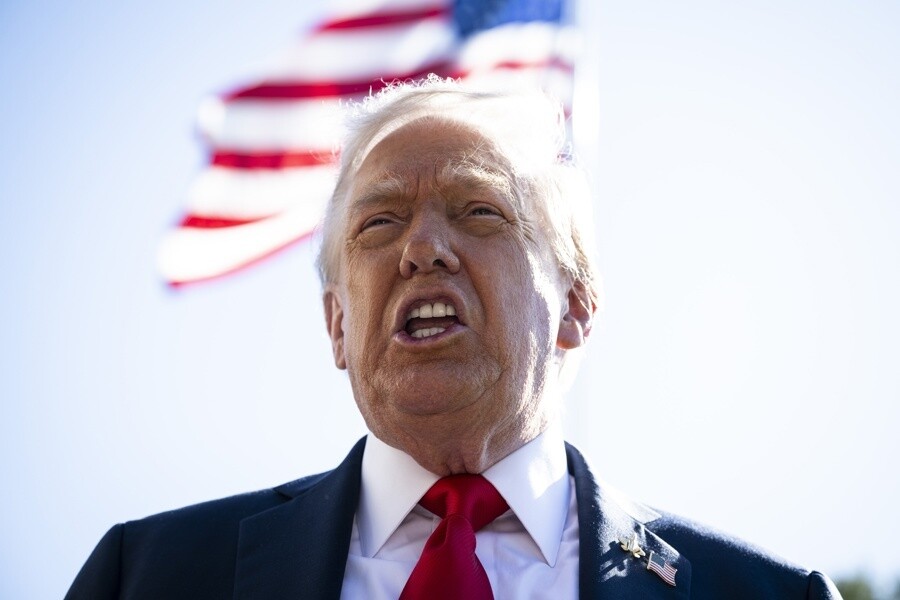
President of the United States Donald Trump completes this Tuesday one year since his return to the White House, a twelve-month period marked by a profound alteration of the international order and the application of a hard-line migration policy that has sparked a wave of social protests.
These are the ten moments that define this first year of his second term:
- The Inauguration Trump was inaugurated for a second term on January 20, 2025, in a ceremony in Washington held indoors due to freezing temperatures, where he proclaimed the beginning of the 'golden age' for the United States.
That same day, he signed a battery of executive orders that set the tone for his government, including pardons for participants in the 2021 Capitol assault and the reversal of several policies of his predecessor, Democrat Joe Biden.
- The Argument with Zelensky The argument Trump had with Ukrainian President Volodymyr Zelensky on February 28, 2025, in the Oval Office before the cameras evidenced the rupture of the unconditional support the U.S. had given Ukraine in recent years.
The Republican, instead, orchestrated an approach to Russian President Vladimir Putin, whom he received in Alaska on August 15, although he has so far failed to end the war he promised to resolve in 24 hours.
- The Mass Deportations Trump came to power with the promise to curb immigration, close the border, and carry out mass deportations, a policy he launched on March 15, 2025, by invoking an 1798 war law to expel more than 200 Venezuelans to El Salvador, accused of belonging to criminal organizations.
The case of Kilmar Ábrego García, a Salvadoran deported despite having a judicial order protecting him, became a symbol of the opposition to these measures, which have sparked protests in numerous cities across the country.
- The Trade War Trump baptized April 4, 2025, as 'Liberation Day,' when he announced a battery of tariffs against much of the world, including the United States' main trading partners, arguing to strengthen national industry and security.
The measures rocked financial markets, and the White House began to negotiate certain exemptions with several countries to try to avoid an increase in inflation in the United States.
- The Break with Elon Musk Trump forged a close relationship with billionaire Elon Musk, to whom he entrusted the task of leading the dismissal of thousands of federal employees and the closure of historic entities like the U.S. Agency for International Development (USAID), but the alliance broke due to disagreements over the tax cuts law and a growing ego battle.
Both starred in a bitter public dispute on June 5, 2025, in which the Republican president threatened to withdraw government contracts from companies linked to Musk.
- The Bombing of Iran The United States bombed three Iranian nuclear installations on June 22, 2025, with the aim of damaging its atomic program and delaying the Islamic Republic's capacity to develop a nuclear bomb.
The attack, which came after a series of Israeli bombings, ended negotiations between Washington and Tehran to reach a new nuclear agreement.
- The Ceasefire in Gaza Trump achieved a ceasefire and hostage release agreement in the Gaza Strip, signed on October 9, 2025, in Egypt, which provides for the formation of a government for the enclave under the direct supervision of the U.S. leader himself.
Despite the agreement, subsequent Israeli attacks have caused the deaths of hundreds of Palestinians; Hamas has yet to locate or hand over the remains of one of the hostages, and humanitarian aid continues to arrive in insufficient quantities.
- The Destruction of the East Wing Trump, a former real estate magnate, wanted to leave his architectural mark and ordered the construction of a grand ballroom in the White House, which led to the demolition of the historic East Wing on October 20, 2025.
Additionally, the president has added gold finishes to the Oval Office, paved the Rose Garden, renamed the Kennedy Center for the Performing Arts with his surname, and plans the construction of a large triumphal arch in the capital.
- The Publication of the Epstein Papers Pressed by sectors of his own party, Trump signed on November 19, 2025, a law, backed by both Republicans and Democrats, that obliges the government to make public the documents of the investigation into the pedophile Jeffrey Epstein, who died in prison in 2019.
There are no criminal indications linking Trump, who maintained a friendly relationship with Epstein years ago; however, his evasiveness on the issue opened a rift with the most radical sectors of his electoral base.
- The Arrest of Maduro After months of military pressure and threats against Venezuela, the United States launched an operation on January 3, 2026, that culminated in the capture of President Nicolás Maduro and his wife, Cilia Flores, transferred to New York to face drug trafficking charges.
Since then, Trump has strengthened relations with the new government headed by Delcy Rodríguez, former vice president of Maduro, while he has sidelined the opposition leader María Corina Machado from the transition process, who even handed him her Nobel Peace medal as a gesture of rapprochement.