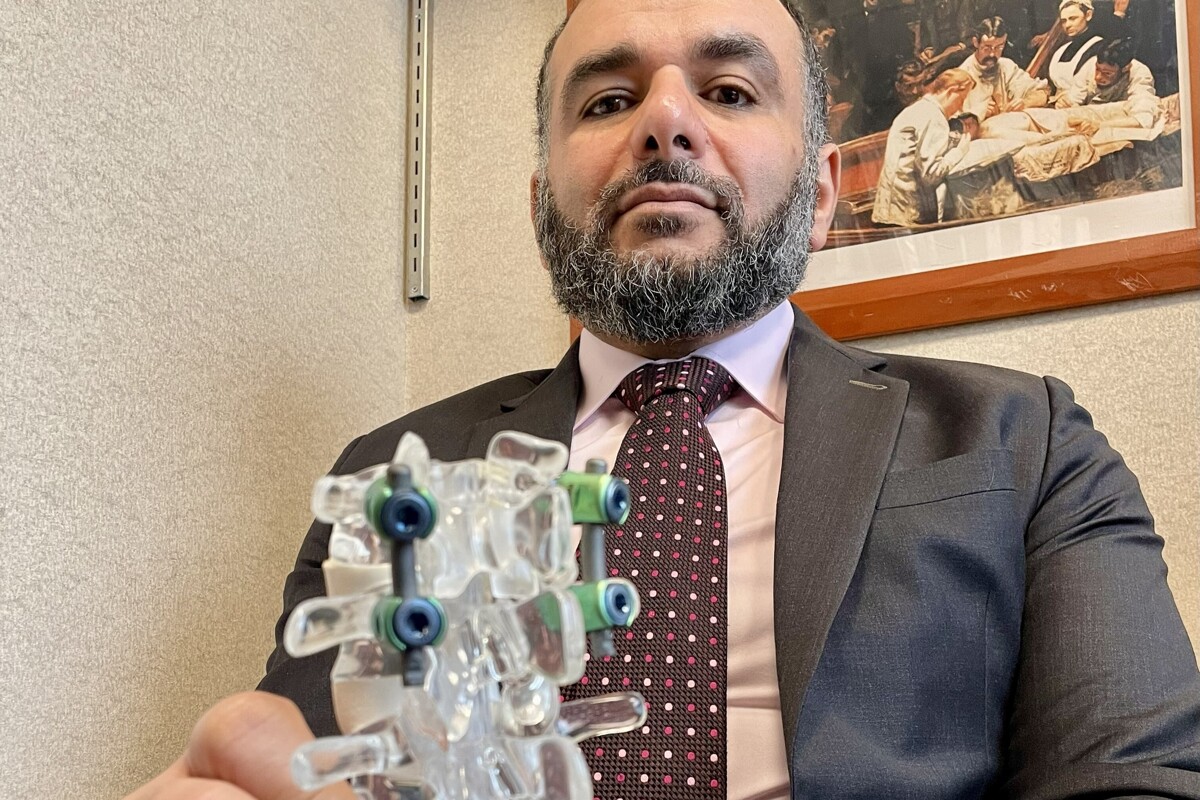
For those who need surgery for spinal conditions, advances in robotics, artificial intelligence (AI), and motion-preserving implants are expanding treatment options and enabling more personalized care, according to Ahmad Nassr, M.D., an orthopedic surgeon at Mayo Clinic.
Dr. Nassr treats a wide variety of spinal pathologies that can affect mobility and cause pain, including: • Herniated disc, a problem with one of the rubbery cushions, called discs, that sit between the stacked bones that form the spine. • Spinal stenosis, a narrowing of the space around the spinal cord that can press on the cord and nerves running along the spine. • Scoliosis, a sideways curvature of the spine that can cause pain and breathing problems. • Spinal tumors, lesions that originate in the spine or its surrounding structures. • Degenerative spine disorders, which most commonly affect older adults, such as degenerative disc disease and adult degenerative scoliosis.
In the realm of research, Dr. Nassr uses AI to better assess bone health and osteoporosis in patients who may need spine surgery.
«Advances in spine surgery are improving patient care and our ability to offer increasingly personalized treatments,» states Dr. Nassr.
«These technologies are changing the way spine procedures are performed and can favor a faster recovery for patients.»
Advances in anesthesia, including specialized nerve blocks, have also significantly improved postoperative comfort and reduced hospital stays.
Personalized Surgery with 3D Models
In complex cases, surgeons can create 3D-printed models of a patient's spine—including nerves and blood vessels—and design custom implants tailored to each person's anatomy.
These models allow procedures to be rehearsed before surgery and surgical planning to be refined.
Complex cases—such as advanced adult scoliosis, revision surgery, or spinal tumors—often involve a multidisciplinary team of specialists, including orthopedic surgeons, neurosurgeons, anesthesiologists, and rehabilitation specialists.
AI in Spine Treatment
Artificial intelligence is integrated into multiple aspects of spine care at Mayo Clinic.
AI-based tools help analyze clinical data to guide treatment decisions and improve surgical planning.
These conditions can cause severe symptoms, such as stiffness, numbness, or even tingling due to nerve damage.
Research has shown that low back pain is the leading cause of disability worldwide, and older adults are one of the most vulnerable populations.
«In my practice, I evaluate each patient holistically, regardless of age, to determine if they can benefit from spine surgery based on the treatment goal, whether it's to reduce pain, regain the ability to work, or improve their quality of life,» explains Dr. Nassr.
Motion-Preserving Alternatives to Fusion
Many spine conditions—such as degenerative disc disease, scoliosis, and spinal stenosis—used to be treated with fusion surgery, in which two or more spine bones are connected and heal into one bone.
The procedure reduces pain but also limits the flexibility of the spine.
Motion-preserving devices, such as artificial disc replacement, offer alternatives that maintain a more natural movement of the spine.
Dr. Nassr was the principal investigator at Mayo Clinic in randomized controlled trials that led to the Food and Drug Administration (FDA) approval of the TOPS device, which stabilizes the spine while preserving motion.
The device can be used to treat compressed nerves and spondylolisthesis, a condition in which one vertebra slips over another.
Mayo Clinic was the first medical center in the U.S. to implant the FDA-approved Minimally Invasive Deformity Correction (MID-C) device to treat scoliosis.
Dr. Nassr and other researchers are studying next-generation implants designed to replace both the intervertebral disc and the facet joints, with the goal of maintaining the spine's natural flexibility.
Robotics and Minimally Invasive Surgery
Surgeries that once required large incisions can now be performed through small openings, reducing postoperative pain, helping patients recover more quickly, and shortening hospital stays.
Conditions like herniated disc, spinal misalignment, spinal stenosis, or spinal instability can now be treated with minimally invasive approaches.
Robot-assisted platforms, combined with CT and MRI, allow surgeons to plan complex spine procedures and determine the most precise trajectories for implants before surgery begins.
«Advances in robotic-assisted surgery, AI, 3D models, and motion-preserving implants allow us to treat complex spine conditions with greater precision and with less impact on the back muscles,» says Dr. Nassr.
(27/Mar/2025 – web – Panama24Horas.com.pa)
Rochester, United States. — People from all over the world are seeking medical care for back and neck pain, which can interfere with sleep, mobility, and daily life.