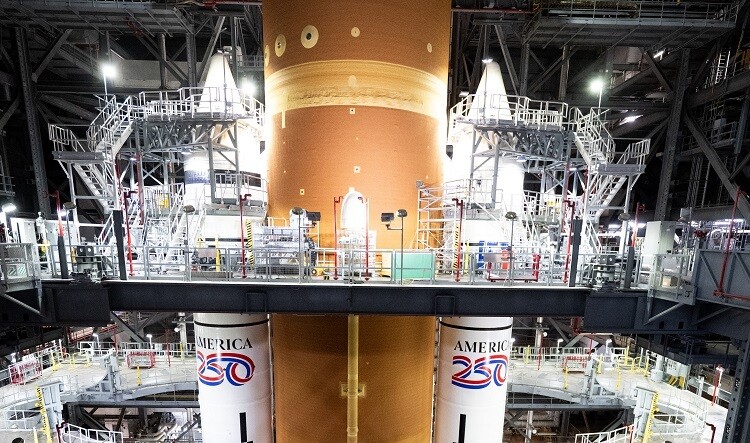
This year, the Artemis II mission will carry four astronauts on a historic flight around the Moon. This Saturday, it will take a decisive step with the transfer and assembly of the Space Launch System (SLS) rocket and the Orion capsule at the Kennedy Space Center's launch pad in Florida. This is a complex logistical operation that can last up to 12 hours and will mark the return of a human crew beyond low Earth orbit, something that has not happened since the Apollo 17 mission in 1972. The rocket's move from the assembly building to the pad, at an approximate speed of 1.6 kilometers per hour along a 6.5-kilometer route, is considered one of the most delicate moments in pre-launch preparation, NASA executives explained during a press conference. For the space agency, Artemis II represents a historic moment within the lunar program and a fundamental step toward future crewed missions to Mars, said Jacob Bleacher, NASA's chief exploration scientist. “This will be our first step toward a sustained human presence on the Moon,” the official emphasized, highlighting the significance of once again placing astronauts on a deep space flight. Mission officials confirmed that a launch window starting February 6 is considered viable and extends through April. It stands about 98 meters tall, weighs over 2.6 million kilograms when fully loaded, and is designed for deep space crewed missions. Unlike SpaceX's Starship, still in the testing phase, the SLS has already successfully completed an uncrewed lunar flight during the Artemis I mission in 2022.
The Orion capsule and its crew The Orion capsule, approximately five meters in diameter and 26 tons in weight, features advanced life support systems, radiation protection, long-range communications, and a heat shield capable of withstanding the intense re-entry into Earth's atmosphere. During the 10-day mission, it will be home to four astronauts from the United States and Canada, including a woman. Its success will be key to advancing to Artemis III, which envisions the return of astronauts to the lunar surface. Bleacher also noted that the mission will offer a unique opportunity to observe the far side of the Moon, a region never directly seen by humans from Earth.
NASA's most powerful rocket The Space Launch System (SLS), developed in collaboration with Boeing and Northrop Grumman, is the most powerful rocket ever built by NASA. The Orion spacecraft will perform a fly-around of the Moon without a landing, following a 'free return' trajectory that will allow it to return to Earth using lunar gravity. The mission will validate the propulsion, navigation, communication, and life support systems, marking the closest human approach to the Moon since the Apollo era.
The crew The crew consists of Reid Wiseman, commander; Victor Glover, pilot; and Christina Koch, mission specialist, all from NASA; and Jeremy Hansen of the Canadian Space Agency, who will be the first Canadian to orbit the Moon. Koch holds the record for the longest single spaceflight by a woman, at 328 days. In case of technical delays, Launch Director Charlie Blackwell-Thompson indicated that there are launch opportunities practically every month.